

If you have ever watched a strong deal crumble for reasons no one can quite explain, that is almost always the result of having no predictable sales process. It is rarely a subpar product or a weak sales team. The problem is the absence of a clear system that carries every rep through every stage of the deal in a way that scales.
So what is a sales process? At its essence, a sales process is a standardized, repeatable workflow that moves a prospect from first contact through to a closed deal and into the relationship that follows. It is the difference between a team that hopes it can close a deal and a team that knows exactly how deals get closed.
Studies show that 55% of revenue leaders have lost revenue because of the absence of an established sales process. That is not a product problem, and not even a people problem. It is a system problem and the good news is that it is completely fixable once you know what to look for.
Companies with a defined sales process grow revenue 18% faster than those without one. You do not get that kind of lift from hiring more reps or doubling your ad budget. You get it from a repeatable, predictable way of selling that your entire team can follow and improve on over time.
A single percentage-point lift in your conversion rate can unlock a 25 – 40% increase in pipeline revenue without sourcing a single new lead. That is the payoff of investing in how you sell rather than the volume of what you sell. Whether you are starting from scratch or patching leaks in an existing system, this guide provides the blueprint for doing it right.
What Is a Sales Process?
A sales process is a repeatable set of predictable actions a salesperson takes to move a prospect step by step – from first contact, to a closed deal, and on through the retention and growth stages of the relationship.
It tells your team what to do at every stage, when to do it, and what has to be true before a deal can advance. Think of it as your organization’s GPS for revenue. A good process does not dictate every word a rep says – it gives them a tested path and lets them navigate the details themselves.
The difference between a sales process and a sales funnel is a common confusion worth dispelling quickly. A sales funnel is a marketing model that shows where buyers sit in their decision journey – awareness, consideration, decision. It is framed from the buyer’s point of view and usually owned by marketing. A sales process, by contrast, is an internal business workflow owned by the sales team. The funnel describes where prospects are; the process describes how they move to the next stage.
Why a Structured Sales Process Matters?
The sales process is often treated as a salesy, jargon-heavy, inconsistent tool-set that reps and leaders are expected to master on instinct. A few practices work, a few don’t, and nobody really knows which. That is exactly the problem sales process management exists to solve – and the case for fixing it has never been stronger.
1.Revenue Predictability
Once your team operates within a repeatable process, revenue stops feeling random and starts behaving like a system. Investing in a formalized sales process leads to higher win rates, faster onboarding, and dependable forecasting – and the data proves it at every level. Without that framework, revenue targets become aspirational at best and misleading at worst. According to Clari’s Revenue Leak Report, 61% of companies missed their revenue goals last year, and much of that traces back to having no proven way of determining how deals flow through the pipeline.
2.Better Conversion Rates
A strong sales process does more than streamline activity – it directly affects how many prospects become customers. When every rep runs the same proven steps, fewer deals fall through the cracks and more conversations reach a natural decision. Companies that align their sales process with marketing can lift win rates by as much as 38% – a significant gain derived entirely from process discipline, with no extra headcount or budget required.
3.Team Alignment
One of the quieter advantages of sales process optimization is what it does for team cohesion. When everyone works from the same playbook, reps don’t reinvent the wheel on every deal and managers spend less time firefighting. 92% of sales leaders say they rely on team collaboration to keep their sales process current – which means a shared process is more than an operational tool; it is the foundation that makes meaningful collaboration possible in the first place.
4.Sales Consistency
Consistency is what separates a high-performing team from one that simply got lucky for a month. 88% of sales leaders say standardizing the sales process improves sales training – enabling quicker onboarding, clearer visibility into rep performance, and best practices that can be learned directly from your top closers.
5.Better Forecasting
One of the most underestimated benefits of a disciplined sales methodology is how much it improves forecasting accuracy. 51% of sales teams reported better forecast accuracy after adopting a formal sales methodology, giving leadership the confidence to make decisions on hiring, pipeline investment, and growth targets. Even the best forecasting tools sit on a shaky foundation when there is no structure underneath them.
Taken together, these five outcomes make the case plainly: sales process improvement is not a frontier leadership explores when time allows. It is the foundation the rest of your sales strategy depends on to operate dependably.
The 7 Key Stages of a Sales Process
High-performing B2B sales processes fit into seven essential stages. What distinguishes genuine process design from generic stage-labelling is the exit criteria – the exact conditions that must be true before a deal can progress.
1. Prospecting
Prospecting is the heart of your sales pipeline. Without a steady, qualified stream of new prospects entering the top of the funnel, the rest of the process suffers no matter how brilliant your pitch is.
Good prospecting begins with a clear Ideal Customer Profile (ICP) – the firmographic, behavioural, and situational signals that describe who is most likely to buy, succeed with your solution, and stay. The sharper your ICP, the more targeted and effective your prospecting becomes.
From there, channel mix matters. Outbound prospecting – personalized LinkedIn outreach, sequenced email, and phone – remains one of the most reliable ways to get in front of your target buyers. Cold outreach done well opens doors that volume-based blasting never will. Meanwhile, inbound lead generation – content, SEO, events, referrals, and thought leadership – produces warmer entry points that tend to advance faster. The best B2B teams run both in parallel.
2. Qualification
Not every lead is a good lead. Qualification keeps your pipeline productive, your team focused, and your forecast honest.
The most common qualification frameworks – BANT (Budget, Authority, Need, Timeline), MEDDIC, and CHAMP – all aim to answer the same core questions: Is this prospect genuinely struggling with a problem your solution resolves? Are they funded, and do they have the authority to decide? And does the timing demand action now, not later?
The hard truth about qualification is that you have to be brutally honest, even when a deal looks appetizing. Pushing an unqualified opportunity into the pipeline doesn’t improve your metrics – it makes them lie. It creates false confidence in your forecast and burns months chasing something you were never going to win. Disqualify early. It is one of the highest-leverage moves an account-focused sales team can make.
3. Discovery Call
Discovery is where many B2B deals are won or lost – long before a proposal ever goes out. A discovery call is not a sales pitch. It is a structured conversation built to listen, ask probing questions, and uncover what is truly at stake for this buyer right now.
Excellent discovery goes well beyond surface-level symptoms. It examines the cost of the status quo: What have they already tried? What does success look like in six or twelve months? What does that outcome mean for the other people at the table? The answers form the foundation for everything that follows – the proposal, the presentation, the negotiation, and the close.
This is also where consultative selling lives. The most effective B2B salespeople don’t treat discovery as information-gathering – they treat it as thinking strategically with the buyer. They offer perspective, ask questions that reframe the problem, and help prospects see their own situation more clearly than they could alone. That kind of conversation builds trust far better than any pitch deck. For a deeper look at running discovery the way the best advisors do, Sales Unlearned treats discovery as the foundation of every real enterprise conversation.
4. Proposal or Presentation
Once you fully understand the problem, you can bring a solution – and the critical point is that the presentation must reflect what you learned in discovery, not what your marketing team wrote last quarter.
The most effective proposals in complex B2B sales are framed in the buyer’s language, priorities, and definition of value. They reference the specific challenges that surfaced, speak to outcomes that matter to this organization, and demonstrate understanding before asking for a decision.
Decision-makers are not evaluating features – they are evaluating whether the investment produces a quantifiable return relative to cost, operational disruption, and risk. Keep the focus firmly on outcomes. A proposal that leads with features will always lose to one that leads with business results.
5. Objection Handling
Objections aren’t barriers – they are chances to learn why a prospect isn’t ready to move forward. Questions about price, timing, competition, or risk are usually signals about where the buyer needs more clarity and confidence.
Rather than getting defensive when an objection surfaces, disciplined sales teams get curious. The right questions get you to the real concern, deepen trust, and produce better conversations. In complex B2B and enterprise sales, handling objections means engaging the differing concerns of multiple stakeholders and moving everyone toward one confident, unified decision.
6. Closing
Closing is the natural result of a well-run process – not a high-pressure moment that demands special tactics. When prospecting was focused, qualification was strict, discovery was thorough, and the proposal was tailored, closing is often just a matter of removing the last bit of friction and helping the buyer make the decision.
That said, closing still requires intent. Deals that aren’t explicitly moved forward tend to stall and hang indefinitely. Be explicit about next steps. Put timelines on decisions. Simplify the path to commit – a one-click e-signature, a clean contract, or a clear kickoff plan that makes “yes” feel low-risk. The best closers don’t pressure – they clarify. They recap value, resolve any remaining objections, and make it genuinely easy to say yes.
7. Follow-Up and Retention
Closing the deal is not the end of the sales process – it is the start of the customer relationship. And that relationship, when nurtured, becomes your most dependable source of future revenue through renewals, upsells, cross-sells, and referrals.
This is where most sales teams skimp. Check in shortly after onboarding to confirm the customer is realizing value. Return to the original objectives set in discovery and measure against them. Stay in touch regularly – not to sell, but to advise. That cadence of genuine, consultative contact turns satisfied customers into advocates who bring you into their next role, refer you across their network, and deepen their commitment over time.
How to Build a Sales Process That Scales
A scalable sales process brings consistency, improves conversion rates, and drives revenue growth without overwhelming operations.
01 – Understand Your Buyer Journey
Map every touchpoint to understand how buyers actually make decisions.
Key stages: Awareness, Consideration, Decision, and Post-purchase engagement.
Goal: deliver the right solution at the right moment in the buyer’s lifecycle.
02 – Define Your Ideal Customer Profile (ICP)
Focus on the prospects most likely to buy and stay.
Your ICP should include: industry, company size, revenue range, location, business challenges, and buying habits.
A well-defined ICP saves time and builds a higher-quality pipeline.
03 – Map Your Sales Stages
Guide every deal through defined stages for better visibility and accountability.
Standard sales stages: Lead Qualification, Discovery Call, Needs Assessment, Product Demo, Proposal / Negotiation, Close, and Customer Onboarding.
Each stage should define its key activities, expected outcomes, and KPIs / conversion benchmarks. A structured process drives consistency and improves results.
04 – Implement a CRM
A CRM centralizes data, automates tasks, and enables team collaboration.
Key CRM capabilities: lead tracking, pipeline visibility, automated follow-ups, activity monitoring, forecasting and reporting, and integration with marketing tools.
A CRM brings order, consistency, and scalability to your sales process.
05 – Track the Right Sales KPIs
Measure performance and drive revenue growth with the metrics that matter.
Key sales KPIs: Lead-to-Opportunity Conversion Rate, Opportunity-to-Close Rate, Average Sales Cycle Length, Customer Acquisition Cost (CAC), Revenue per Sales Rep, Pipeline Velocity, and Customer Retention Rate.
Measure. Analyze. Improve. Repeat. Data-driven sales teams win.
06 – The Result: A Scalable Sales Process
When people, process, and technology work together intelligently, your sales process becomes repeatable, predictable, and built to scale.
People → Process → Technology → Growth
Build it. Repeat it. Scale it. A scalable sales process is the foundation for sustainable, long-term growth.
Sales Process Flowchart Explained
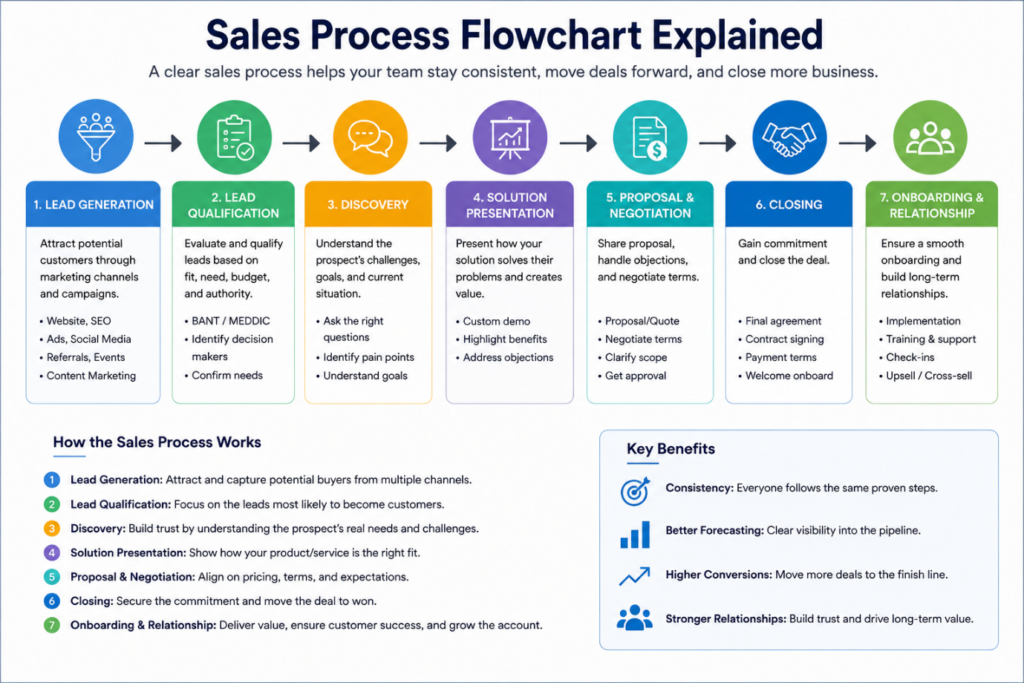
A sales process flowchart maps the entire journey in a clear, visual way, giving everyone insight into how a deal actually moves. It typically runs from prospecting and lead generation, through lead qualification to identify genuine potential customers, into discovery – where the team learns the customer’s needs and pain points – and on to solution presentation, where you show how your product or service solves those pains effectively.
From there the process moves to proposal and negotiation, where pricing is agreed and the contract is signed. Finally, the onboarding and relationship stage centers on customer support, a successful rollout, and an ongoing partnership. The benefit of a clearly defined sales process is reproducibility: a business can repeat the same flow to amplify efficiency, increase conversions, measure performance, and build stronger customer relationships.
Sales Pipeline Management Best Practices
The sales process is the blueprint; pipeline management is the day-to-day work that keeps the blueprint full.
1.Define your pipeline stages clearly and consistently.
Every rep should work from the same definition of what it means for a deal to sit at each stage. When stage labelling is inconsistent, the pipeline data can’t be trusted, forecasts can’t be trusted, and end-of-quarter surprises arrive that nobody can explain.
2.Run regular, forward-focused pipeline reviews.
A pipeline review is not for updating a spreadsheet – it is for surfacing which deals need intervention and what the team can do to move them forward. Skip the status-only updates. Coaching conversations, next-step clarity, and deal-strategy decisions are where pipeline management earns its keep.
3.Maintain pipeline hygiene.
Deals that haven’t moved in 30, 60, or 90 days don’t strengthen your forecast – they distort it. Purge or re-qualify stale opportunities regularly. A small, realistic pipeline is far more powerful than a large one that creates a false sense of security.
4.Watch deal velocity, not just deal volume.
The number of deals matters, but it isn’t everything. A sudden drop in deal velocity can be the first warning sign of a process breakdown, a market shift, or a coaching gap – and the earlier you catch it, the more time you have to respond.
5.Use pipeline data to forecast with confidence.
When stage definitions are standardized, conversion rates are monitored, and deal velocity is tracked, forecasting shifts from a conversation to a calculation. That predictability is what separates organizations that plan systematically from those that constantly react.
Consultative Selling in Modern B2B Sales
If one approach defines great B2B selling today, it is consultative selling – and that is truer now than ever.
Many sales professionals note that AI has made it far easier for buyers to research products on their own, shifting the salesperson’s role from information provider to advisor and confidence-builder. In a world where buyers arrive informed, a salesperson’s value is no longer information. It is insight, perspective, and genuine empathy for the buyer’s challenges.
Consultative selling runs on discovery-led conversations. It is about better questions, not better answers. It treats every interaction as a problem to be solved rather than a moment to persuade, and it treats the buyer as a partner in the decision rather than a target to be closed.
In practice, that means more time in discovery and less time in demo. It means not pitching solutions before you understand the problem. It means sharing relevant insight from comparable companies or situations so the buyer can think through their decision more clearly. And it means having the discipline to disqualify honestly when your solution isn’t the right fit – because that kind of honesty builds the trust that earns referrals, even from deals you didn’t win.
In enterprise conversations specifically, consultative selling means balancing stakeholders with different priorities, objections, and definitions of value. What separates a transactional rep from a trusted advisor is knowing how to tailor the approach to the economic buyer, the technical evaluator, and the end user – while keeping all of them aligned around a shared decision. This human-first, advisory approach to enterprise selling is the central idea behind Sales Unlearned.
Objection Handling Strategies That Improve Conversions
Objection handling sits at the intersection of emotional intelligence, product knowledge, and strategic communication. Getting it right consistently takes preparation, curiosity, and the discipline to understand before responding.
1.Prepare before every conversation.
The most common objections in your market are entirely predictable. Map them by category – price, timing, competition, trust, internal priority – and develop a clear, evidence-based response to each. When an objection surfaces live, you want to respond from a place of groundedness, not scramble.
2.Get behind the stated objection.
Buyers often raise a surface concern that masks a deeper one. “The price is too high” usually means “I haven’t seen enough value to justify this internally.” “The timing isn’t right” often means “I’m not confident enough in the ROI to take the risk.” Ask clarifying questions and understand the real concern before addressing it.
3.Handle pricing objections with value, not discounts.
Dropping the price at the first sign of resistance trains buyers to negotiate and erodes your margins over time. The stronger move is to revisit the value established in discovery – the cost of the problem, the return on resolving it – and rebuild the justification for the investment.
4.Build trust through transparency.
In enterprise sales especially, trust is the ultimate objection-handler. Buyers who trust you – who believe you understand their situation and have their interests at heart – will work through concerns rather than use them as exit ramps. That trust is built through consistent honesty, follow-through on commitments, and the willingness to say “I don’t know, but I’ll find out” when you don’t have the answer.
High-Ticket Sales and Complex Deal Navigation
High-value B2B sales run by different rules than transactional sales. The stakes are higher, the cycles are longer, and decisions involve more people, more scrutiny, and more risk assessment.
In complex deal navigation, a few principles consistently make the difference. First, map the buying committee early. Know who the economic buyer is, who the technical evaluator is, who will be affected by implementation, and who holds veto power. Then build a relationship with all of them – because a deal with only one champion is always one org-chart change away from disappearing.
Second, ease the buying process, not just the selling process. Arm your champion with what they need to make the internal case. Build clear ROI models, supply reference customers in the same vertical, and walk your champion through the internal path to sign-off. The easier you make it for them to say yes, the faster the decision comes.
Third, sell without pressure. High-value buyers are acutely sensitive to pressure – that is what defines them. In large, complex deals, the moment a rep shifts from value to pressure, trust evaporates and timelines blow out. The aim is to be the consistently useful presence that makes continuing the conversation the path of least resistance.
AI in Sales Process Optimization
Artificial intelligence is no longer a future consideration in sales, it is already reshaping how the best revenue teams operate, and the performance gap between AI-adopters and traditional teams is widening.
71–81% of sales teams are experimenting with or have fully implemented AI, and teams using AI are 1.3 times more likely to see revenue growth than those without it. The applications span every stage of the sales process.
At the prospecting and qualification stage, AI tools analyse firmographic and behavioural data to surface the accounts most likely to convert, prioritise leads by propensity to buy, and detect intent signals that show when a prospect is actively in-market. This makes prospecting sharper and qualification faster.
In CRM and pipeline management, AI-powered analytics identify stalled deals, flag pipeline risks, and surface the specific next actions most likely to move a deal forward – based on patterns from thousands of similar opportunities. 73% of those using AI-powered CRMs agree they significantly boost productivity by automating manual tasks and enabling real-time, data-driven decisions.
For follow-up and outreach automation, AI drafts personalised communication sequences, recommends optimal send times, and triggers reminders based on deal stage and engagement. This removes the single most common reason deals go quiet – a rep who got busy and forgot to follow up.
In forecasting, machine-learning models analyse pipeline data, rep performance, and historical close rates to generate predictions far more accurate than manual estimates. That accuracy carries real business value: it changes how organisations plan headcount, marketing spend, and capacity.
The teams that win over the next five years won’t necessarily be those with the biggest budgets or the most experienced reps. They will be the ones that build a structured sales process and layer intelligent automation on top of it.
How to Audit and Improve Your Sales Process
A sales process isn’t a set-it-and-forget-it document. It is a living system that should be assessed, questioned, and iterated on a regular cadence – at minimum twice a year, and whenever buyer behaviour or the market shifts materially.
1. Perform a sales process audit.
Calculate stage-by-stage conversion rates over a meaningful period. Where are deals entering? Where are they leaking? The stage with the lowest conversion rate or the longest average deal age is almost always where the biggest process gains are hiding.
2.Detecting pipeline leakage.
Are deals stalling between discovery and proposal? Are proposals converting to closes less often than expected? Each pattern points to a different root cause – shallow discovery, weak proposal relevance, poor objection handling, or missing stakeholder access.
3.Review your KPIs against benchmarks.
Compare your average sales cycle length, win rate, and pipeline coverage ratio against peers in your industry or segment. When you fall behind a benchmark, look for the process explanation before the talent explanation.
4.Gather team feedback.
Your reps live in the buyer’s world. Ask them directly: Where do conversations tend to stall? What objections come up most? What support would help most? Combined with pipeline data, that input gives you a far richer view than data alone.
5.Run a CRM review.
If stage definitions aren’t aligned, deal data turns to mush. Confirm every open deal is sitting at the correct stage, and watch for trends in how deals get tagged – and whether those tags reflect reality or aspiration.
Common Sales Process Mistakes
Even well-intentioned sales organizations make structural mistakes that quietly cap their effectiveness. The most common are also the most preventable.
1.No proper qualification framework.
Chasing every lead with a pulse into the active pipeline generates noise, inflates forecasts, and wastes your best reps’ time. A clear, well-defined, consistently enforced qualification methodology is one of the easiest routine wins most teams can claim.
2.Poor or no follow-up.
Most deals don’t close on the first or second conversation – 60% of customers say no four times before they say yes. Reps who follow up inconsistently, or give up after a point, leave enormous revenue on the table. Build follow-up cadences into the process as a structural feature, not a personal habit.
3.Shallow discovery.
Rushing through discovery to get to the pitch is one of the costliest mistakes in B2B sales. A proposal built on thin understanding will always be less compelling, less relevant, and less likely to close than one rooted in a deep grasp of the buyer’s real situation.
4.Overcomplicated pipelines.
More stages don’t mean more precision. A 12-stage pipeline nobody understands or uses consistently is far worse than a clear, well-defined 6-stage pipeline everyone knows how to navigate. Simplicity enables consistency.
5.No CRM adoption.
A sales process that exists only in decks and manager conversations doesn’t scale. If your CRM doesn’t mirror your real process, your pipeline data is fiction – and you are managing by fiction.
6.Abandoning the process when things get busy.
Sales processes most often break down in the hands of busy teams who feel like they’re crushing it. That is precisely when discipline matters most, because that is when good habits either take hold or fall away.
Final Thoughts
The single biggest shift in B2B sales today is this: the best sellers no longer think of themselves as closers. They think of themselves as advisors. They build processes around the buyer’s journey rather than the seller’s convenience. They commit to deep discovery instead of snappy pitches. They use data to get better, not just to report.
A well-crafted sales process is the infrastructure that enables all of this at scale. It turns an individual star into a team capability. It turns gut feel into data-driven decisions. It turns revenue from something that happens to your business into something your business creates deliberately.
The companies that outperform in the years ahead won’t necessarily have the best reps or the biggest marketing budgets. They will have the best systems – and the discipline to keep improving them.
Ready to build a more predictable sales process?
If you want to design a scalable, repeatable sales process and give your team a real advantage in enterprise conversations, the next step is a conversation.
Book a Clarity Call → – a focused one-on-one session on your specific deal, your discovery structure, or the enterprise conversation you can’t afford to get wrong. No frameworks dumped on you. Just clear thinking about your situation.
And if you’d rather start with the thinking behind this human-first, advisory approach to selling, start with the book.
Get Sales Unlearned → the honest guide for engineers, founders, and domain experts navigating enterprise sales without losing themselves in the process.
Frequently Asked Questions
1. What are the stages of the sales process?
The seven critical stages of a sales process are Prospecting, Qualification, Discovery Call, Proposal or Presentation, Objection Handling, Closing, and Follow-Up and Retention.
2. How do you build a sales process?
Start by defining your ICP, then map your stages. Document the specific tasks, questions, and qualifying criteria for each stage, bake the process into your CRM, and set KPIs to monitor performance at every step. Review and refine the process at least twice a year.
3. Why do you need a sales process for B2B sales?
A sales process increases revenue predictability, sales efficiency, team alignment, and the speed at which new hires become productive. In long, complex sales cycles run by multiple decision-makers, process is what keeps deals from stalling and forecasts from falling apart.
4. What is the difference between a sales process and a sales funnel?
A sales funnel illustrates the buyer’s journey through awareness, consideration, and decision – it is a marketing model. A sales process is the internal workflow that defines the actions a rep takes at every stage to move a deal forward. The funnel shows where prospects are; the process shows how they move.
5. How can AI streamline the sales cycle?
AI improves every stage of the sales cycle – surfacing high-intent prospects, prioritizing the pipeline, automating follow-up sequences, producing more accurate forecasts, and coaching reps based on conversation data. AI-driven teams are already outperforming those that aren’t, and the gap is growing.
6. What is consultative selling?
Consultative selling is a problem-solving approach that prioritizes understanding the buyer’s problem before presenting any solution. Instead of pitching products, consultative sellers ask smart, open-ended questions, share relevant insight and perspective, and help buyers think through their needs more completely – earning trust and creating value long before a proposal is ever made.
7. How do you improve your sales pipeline?
Strengthen pipeline management by defining each stage clearly, running frequent deal-level reviews, removing or re-qualifying stale deals, tracking velocity as well as volume, and using pipeline data to make dependable revenue forecasts. Clean, consistent data is the root of everything else.